Researchers chasing pieces by or about Herman Melville, Mark Twain, and Henry James in American magazines from the middle of the 19th century often run into the same problem: the periodicals are vast and the references are scattered. The promise of a single index is simple-stop hunting through separate bibliographies and start finding writers, works, and contemporary commentary in one place. That promise comes with a price, however, and the question is whether a specialized reference can earn that cost for the way you actually work.
This review centers on Daniel A. Wells's The Literary Index To American Magazines, 1850-1900, a reference volume listed at USD 111.93.
Quick verdict
For a researcher, archivist, or serious collector of American literary periodicals, this index earns its keep when the 1850-1900 window matches the project. It collects thousands of references to major and minor literary figures and their works, and it serves as a guide to facts, opinions, and comments on 19th-century literature. It is not a casual coffee-table book; it is a tool for working through a specific historical period.
Who it suits
This volume is best for graduate students, scholars, librarians, and independent researchers who need to locate material from or about 19th-century American writers. It also fits collectors building a reference shelf around American magazines, because an index like this condenses decades of periodical content into a one-volume starting point.
What stands out
The scope is the headline. The index covers American literary magazines from 1850 to 1900 and pulls in references to well-known figures like Melville, Twain, and James, plus minor authors who are easy to overlook. The volume is also structured to work as a guide to what contemporaries said-facts, opinions, and comments-which is useful when you need context beyond a name. The hardcover format, with a 1.1-inch thickness and a 9-inch length, places it firmly on a desk, and the ISBN 9780313298400 gives you a clear way to cite or request the exact edition.
Meaningful trade-offs
The biggest trade-off is the listed price of USD 111.93 combined with the narrow coverage window. If your research begins after 1900 or focuses on newspapers rather than magazines, this particular index will not be the tool for you. The specialized nature of the book is also its limit: it is built for a defined slice of literary history, and any project outside that slice will need a different starting point.
Product note
The Literary Index To American Magazines, 1850-1900
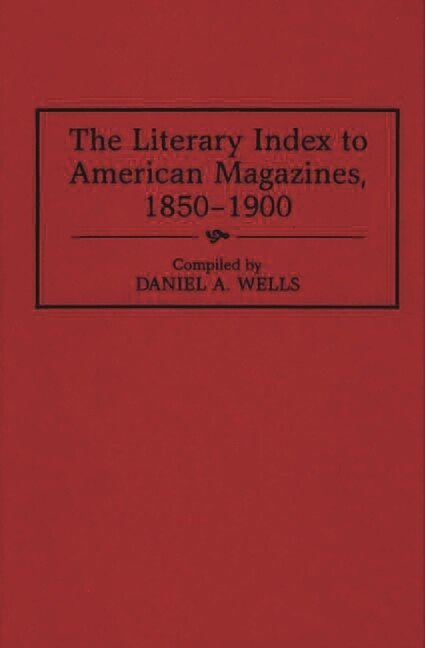
Choose it when you need a dense starting point for finding 19th-century American literary references without assembling dozens of separate bibliographies. The constraint is that its usefulness is tied to the 1850-1900 era, so it only earns its keep when that period is central to your work.
Bottom line
If your work regularly passes through American magazines between 1850 and 1900, The Literary Index To American Magazines is a defensible investment. If your research edges outside that period, the same specificity that gives the book its power also keeps it on the shelf.